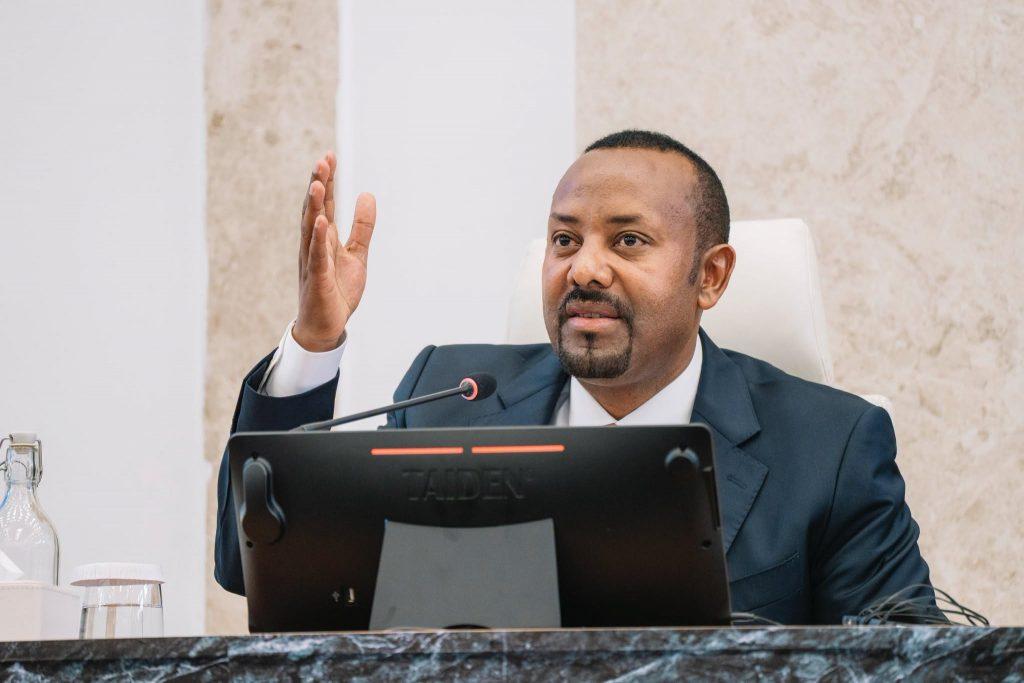
Prime Minister Abiy Ahmed told parliament on 26 November that Ethiopia's rebased economy stands at $210 billion. He said that makes it the third-largest in Sub-Saharan Africa, after South Africa and Nigeria.
Abiy also told the House of Peoples' Representatives that industry had moved ahead of agriculture for the first time, at 31.8% against 31.4%. The Ethiopian News Agency (ENA) and Fana Media Corporation, which both reported the session, described these figures differently.
ENA reported them as each sector's share of gross domestic product (GDP). Fana reported them as projected shares of overall GDP growth in the current fiscal year, for industry and construction combined. In Fana's version, services were projected to make the largest contribution, at 33.8%. Fana also gave projected growth rates of 12.3% for industry and construction, 7.7% for agriculture and 9.9% for services.
Advertisement
Answering MPs' questions, Abiy said Ethiopia's debt vulnerability had fallen from high to moderate earlier than the government had planned. He called this a major success of the reform programme.
Most conservative of three estimates
The $210 billion figure is not new. Finance Minister Fitsum Assefa announced on 4 November that the economy was valued at $210.7 billion in the fiscal year that ended in July 2026, according to Daba Finance. That ranking put Ethiopia fifth in Africa, behind South Africa, Egypt, Nigeria and Algeria.
Abiy told parliament that the rebasing produced three possible estimates and that the government chose the most conservative. He said a considerable informal economy remains outside the measured base.
Ethiopia had gone 11 years without a rebasing, Abiy said. International standards recommend the exercise about every five years. He said the Ethiopian Statistics Service carried out an economic census over more than a year. Thousands of people took part, with support from the World Bank and the International Monetary Fund (IMF).
Abiy said the new figure should be read as an updated measurement of activity that had been poorly captured before, not as a sudden rise in output. Among the activities he said the old framework did not adequately capture were:
- the digital economy
- urban corridor development
- cluster farming
- the Lemat Tirufat poultry, egg and milk initiative
- new industrial parks and energy projects
- the Green Legacy initiative
- conference tourism and tourism infrastructure
Exports and state holdings
Abiy pointed to a substantial narrowing of the gap between the official and parallel foreign-exchange markets. He also cited higher foreign-exchange reserves, stronger exports and rising foreign direct investment. Ethiopia moved to a market-based exchange rate in July 2024. The IMF approved a four-year Extended Credit Facility for Ethiopia, of about $3.4 billion, that same month.
According to Abiy, export revenue reached $3.1 billion in the first three months of the current fiscal year. That was 25% higher than in the same period a year earlier.
He said assets managed by Ethiopian Investment Holdings, the state's sovereign wealth fund, had grown from 2.6 trillion birr to 9 trillion birr. He put its revenue at 3.1 trillion birr. State-owned enterprises created nearly 72,000 jobs in the past three months, he said.
Abiy said about 70 million people now use mobile banking and 11 trillion birr has passed through digital finance. He put bank deposits at 5.3 trillion birr. He also said tax revenue remains low relative to the size of the economy, and called for stronger enforcement and legal measures to widen the tax base.
Citing IMF projections, Abiy said global growth was forecast at 3.1% and Sub-Saharan Africa's at about 4.3%.
On the Ethio-Djibouti Railway Corporation, Abiy said profits had risen from 3.4 billion birr to 43 billion birr. He said the locomotive fleet had grown from 11 to 36. According to the prime minister, the railway carries more than 95% of Ethiopia's coffee exports and 25% of its fertiliser imports.