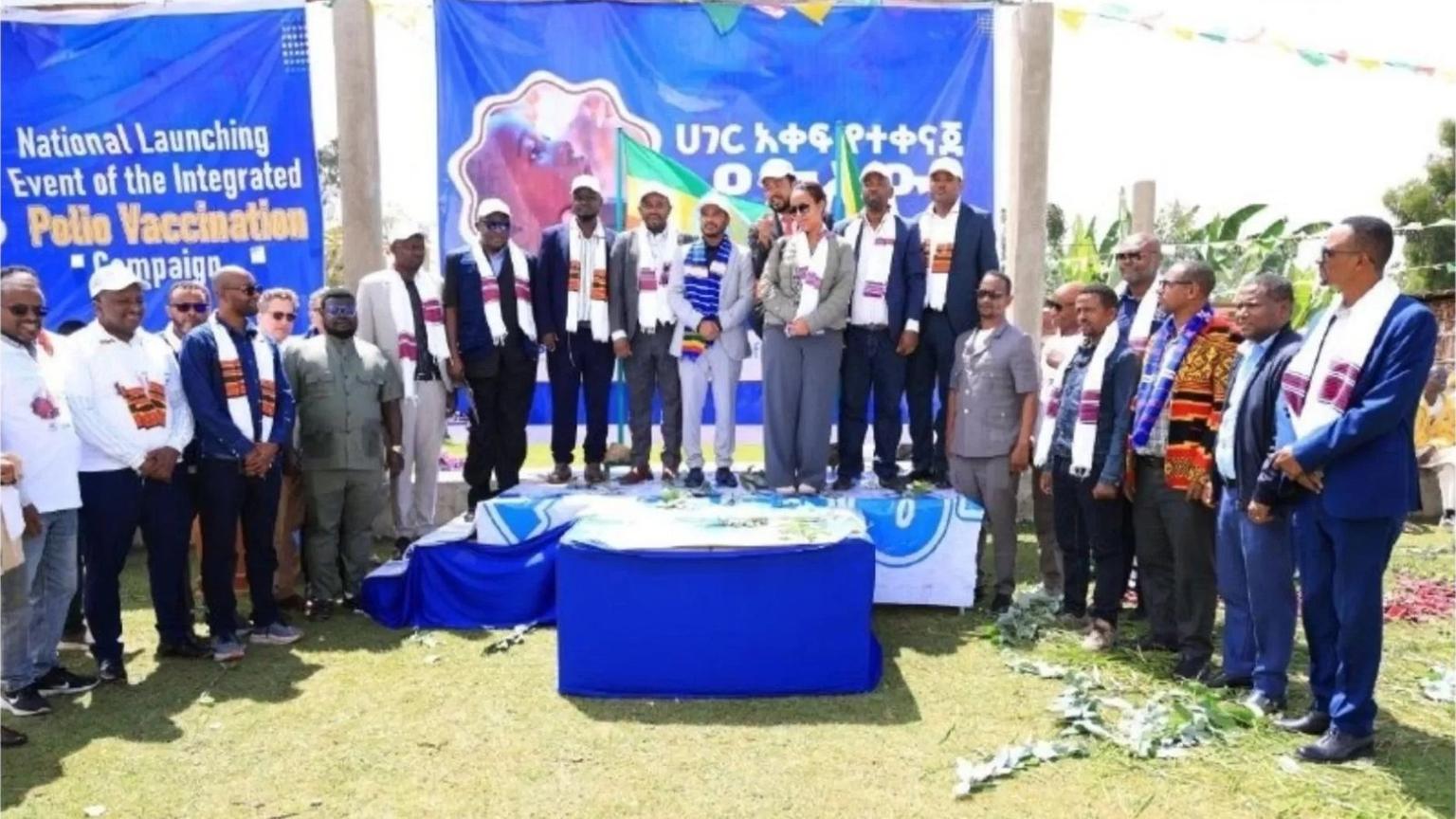
Ethiopia began a house-to-house polio vaccination campaign on 21 November aimed at more than 11.3 million children in five regions. Outbreaks of circulating variant poliovirus type 1 have been reported in the country this year.
The campaign covers Addis Ababa, Oromia, Central Ethiopia, South Ethiopia and Southwest Ethiopia regions. The first round runs from 21 to 24 November, and a second is scheduled for 18 to 21 December. The government is running the campaign with the World Health Organization (WHO), UNICEF, the Global Polio Eradication Initiative (GPEI) and other partners, according to a WHO statement issued at the launch in Arba Minch, South Ethiopia Region.
Teams of health workers and community volunteers are visiting homes to vaccinate eligible children. They are also identifying children who have never received routine vaccines or have missed doses, and linking them to health services.
Advertisement
Ethiopia remains free of wild poliovirus. However, circulating variant poliovirus type 1 has been reported this year in Gambella, Oromia and South Ethiopia regions. On 25 October, the Addis Ababa newspaper Capital cited a joint statement by GPEI partners and reported that 11 cases had been recorded in 2026. According to the paper, five were in Gambella Region, four were in West Shoa Zone of Oromia Region and two were in Gofa and Gardule zones of South Ethiopia Region.
Capital put the campaign's target at 11,348,548 children across 629 woredas, Ethiopia's district-level administrative units, and 68 zones.
The current campaign follows earlier outbreak-response rounds in Gambella, Benishangul-Gumuz and parts of Oromia, including West Wollega and Kellem Wollega. WHO said those rounds reached more than one million children.
Dr Loveday Nkwogu delivered the partners' joint speech at the launch on behalf of Prof Francis Kasolo, the WHO Representative to Ethiopia. "While significant progress has been made, poliovirus continues to threaten children wherever immunity gaps exist," the speech said. It called on parents, community leaders, health workers and partners to make sure every eligible child is reached.
WHO said it had deployed 28 staff from its central and field offices. They are supporting coordination, planning, the training of health workers and supervisors, data management and community engagement. WHO has also trained independent monitors and lot quality assurance sampling surveyors, who will check the quality of the campaign during and after the vaccination rounds.
Health authorities and partners are also pressing to strengthen surveillance so that poliovirus transmission is detected early. This includes monitoring for acute flaccid paralysis, a sudden weakness of the limbs, and environmental monitoring.