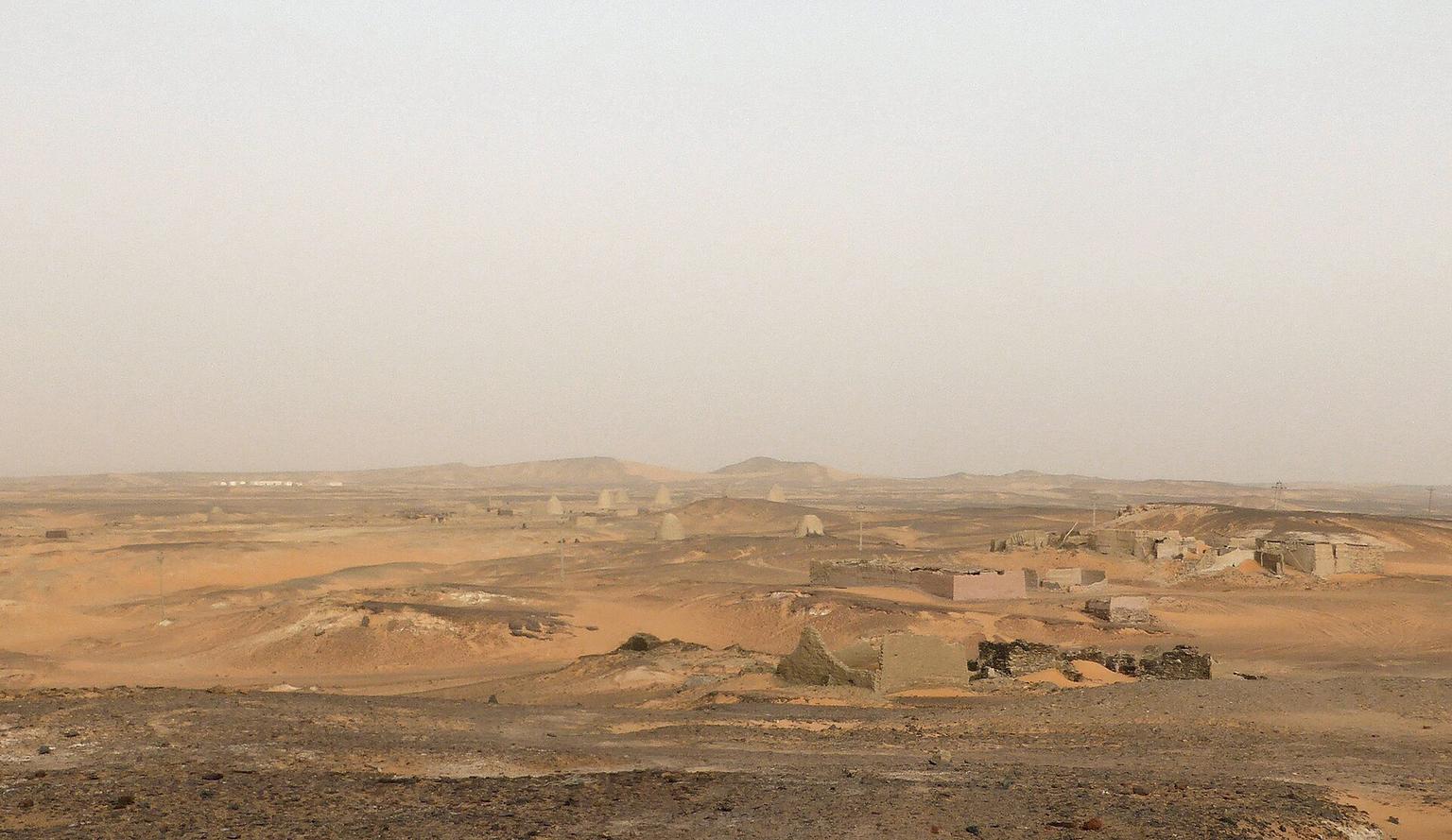
Archaeologists in northern Sudan have reached the original floor of the Great Church of Jesus at Old Dongola for the first time, uncovering part of a vast medieval building that may have served as the cathedral of the Christian kingdom of Makuria.
The Sudanese-Polish team found a monumental staircase leading down to the church floor, with surrounding walls preserved to a height of about 11 metres. The structure was first identified in 2021, but only the staircase area has so far been excavated down to floor level.
Researchers now estimate that the church was about 47 metres wide and 57 metres long, with a possible height of around 21 metres. Those figures are provisional: the staircase is the only area where the team has reached floor level, and further excavation is needed to establish the building's full dimensions.
Advertisement
The work is led by Artur Obłuski of the University of Warsaw's Polish Centre of Mediterranean Archaeology in cooperation with Sudan's National Corporation for Antiquities and Museums. In its announcement of the new findings, the university said some medieval Arabic texts described the Great Church of Jesus as Nubia's largest and wealthiest church.
Old Dongola, on the Nile in what is now northern Sudan, was the capital of Makuria, a major Christian Nubian kingdom. Archaeologists believe the Great Church of Jesus may have been the city's cathedral, a role previously attributed to another church outside the citadel. If it was the cathedral, the university said, that other church must have had a different function.
Obłuski also suggested that the Great Church of Jesus could have influenced church design across Nubia, comparing its potential architectural importance to that of Hagia Sophia in Constantinople. The comparison concerns its possible influence, rather than an established architectural connection.
A second church and Greek texts
Excavation of a structure adjoining the main church also revealed a smaller place of worship built on an upper floor. Although its walls survive to only about a metre, the team recovered substantial fragments of painted plaster.
Some fragments bear Greek religious texts identified as biblical canticles, or songs of prayer. The texts include part of the Prayer of Hannah, the mother of the prophet Samuel. Agata Deptuła, who examined the fragments, said the surviving Greek letters are about half a centimetre high. Such biblical songs had not previously been identified among the site's inscriptions, where texts from the Psalms were better known.
Preserving the site during Sudan's war
Sudan's war has disrupted water supplies in the area. In 2024, the area's worst flooding since 1988 damaged roofing that protects archaeological remains.
Engineers from Warsaw University of Technology joined work to stabilise the site. A photovoltaic installation funded by Poland's Polish Aid programme now powers pumps supplying Nile water to the homes of roughly 10,000 people and irrigating fields. Pressure boosters were also installed at eight stations to reach homes on higher ground that had lost water during the war.
The team plans to determine the church's full dimensions in its next excavation season.